
Context and challenges
To implement the Water Framework Directive (WFD), both public authorities and the private sector need to enhance their commitment to more effectively evaluating the ecological health of watercourses. One of the main challenges is achieving an accurate understanding of the potential impact of their emissions on aquatic environments, to better support targeted improvement efforts.
However, traditional biological assessment methods – based on sampling and morphological identification of organisms – have several limitations. They are often expensive, time-consuming, and heavily reliant on expert knowledge. Moreover, some indicator species, such as the freshwater pearl mussel or thick-shelled river mussel, can be rare, elusive, or difficult to detect through these methods.
These limits reduce both the frequency and depth of ecological monitoring, precisely when increasing pressures on aquatic environments require more adaptive and precise tools.

An innovative tool : environmental DNA (eDNA)
To overcome these limitations, E-BIOM and its partners have turned to an increasingly used innovation in environmental monitoring: environmental DNA (eDNA). This technology captures and detects genetic traces left in the water by living organisms — through their cells, mucus, excrement, or tissue fragments — without needing to capture or directly observe them.
This approach has several advantages: it is faster, less invasive, and can build a broader inventory of species, including those typically undetected by traditional methodologies and techniques. It also improves standardization, since identification is based on genetic sequences rather than human interpretation. Integrated within rigorous protocol, eDNA analysis is highly effective in detecting fine-scale changes in biological communities, even near discharge sites.
Read our dedicated article on eDNA.
In practice …
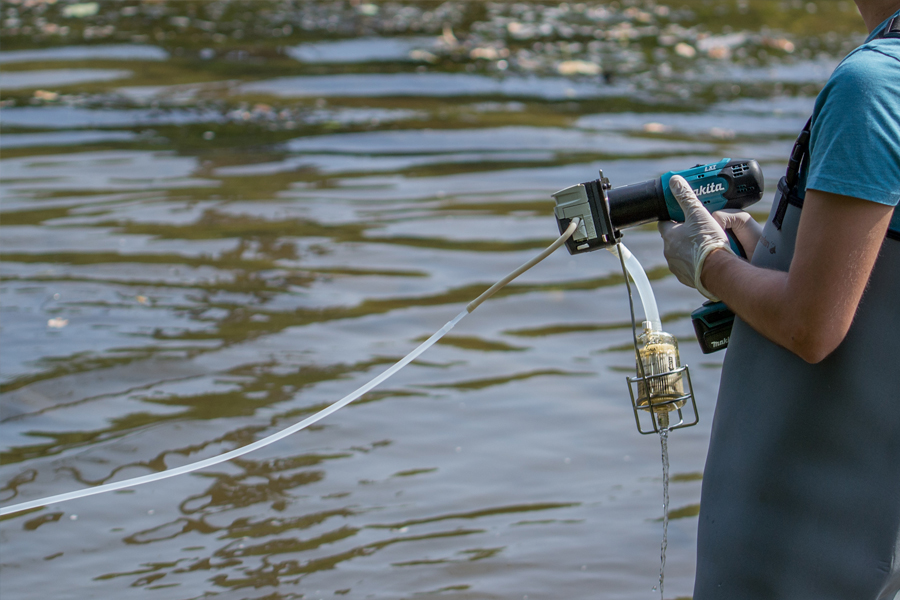
As part of this project, water and diatom samples were collected from ten sites across six rivers in Wallonia to assess the impact of effluents on biological communities. Two types of samples were taken: benthic diatoms and water samples, to detect the presence of the freshwater pearl mussel (Margaritifera margaritifera) and the thick-shelled river mussel (Unio crassus), two Natura 2000 species currently threatened in Wallonia and Europe.
DNA was extracted from these samples in E-BIOM’s laboratories and then analyzed using bioinformatics pathways to identify the target species.
Robust biological DNA-based indicators
The eDNA analysis enabled accurate characterization of diatom communities, which are microalgae sensitive to water quality changes and widely used as bioindicators in monitoring networks. Several key ecological metrics were calculated directly from the DNA sequences.
These indicators help to detect possible organic pollution, herbicide presence, and the level of nutrient enrichment in rivers (also known as eutrophication). Moreover, they demonstrated strong consistency with ecological status values previously established for Walloon rivers using traditional methods, thus validating the reliability of the eDNA approach for regulatory monitoring.
eDNA analysis confirmed the presence of sensitive indicator species, including those typically missed by traditional surveys, such as the freshwater pearl mussel. This information plays a crucial role for prioritizing restoration actions and refining management measures in sensitive areas.
A science-based decision support tool
This pilot project not only produced valuable scientific results but also demonstrated that eDNA is a viable tool for regulatory applications. By rapidly providing reliable, standardized, and site-comparable data, eDNA facilitates dialogue among managers, scientists, and authorities.
This method not only effectively reflects the overall state of aquatic environments but also refines ecological diagnostics by offering detailed insights into community structures, particularly diatoms. This innovative approach enables more sensitive, faster monitoring, better suited to adaptive management and the continuous improvement of water quality.
eDNA is emerging as a true decision-making tool, with a focus on adaptive monitoring and ongoing enhancement of aquatic ecosystem health.