
More than half of the world’s population lives in cities, according to the World Bank. By 2050, the number of urban dwellers is expected to double. Given such urban growth, it is evident that animals have had to adapt. Some have done so so successfully that, in a way, they have become true city dwellers.
In this article, we focus on the animal species living in cities in Belgium. We will explore how they have developed there and, most importantly, what challenges these developments present.

The Origins of City Creation
Historically, humans, the quintessential social species, once abandoned nomadism to settle in fixed locations. At that time, the development of agriculture and animal domestication allowed individuals to gather in villages. Thus, communities were created. These communities were organized around various services and activities and governed by different powers.
Gradually, the villages expanded and became cities. Over time, these cities were divided into neighborhoods, according to the status of their inhabitants. Fortifications were then built. Later, under the influence of the Romans and their innovations, particularly regarding hygiene and sanitation, the city continued to evolve.
During the industrial era, population growth exploded. Fortifications were demolished to make room for new neighborhoods. Materials like concrete, glass, cast iron, and steel made their way in. The city thus became an artificial creation, considered the domain of humans. However, it also houses other living beings.
The City: A Hostile Place for Animal Life?
Urban Characteristics Unfavorable to Animal Development
Urban spaces have their own characteristics: higher temperatures, artificial, impermeable, and fragmented soil, almost constant lighting, noise pollution, and pollution from various gas emissions (road traffic, industrial activities, heating, etc.).
Downtown areas with high human concentration form an unwelcoming microclimate. Animals and nature have little space to develop. As a result, wildlife struggles to settle and find food.
Furthermore, urbanization leads to fragmentation of space, especially through roads. This fragmentation can prevent certain wild species from moving as they once did, weakening them.
The animals’ ability to adapt to urban space
Nevertheless, some animals have shown remarkable adaptability to their environment. This is known scientifically as phenotypic plasticity. They have managed to adjust their behavior and morphology to the available resources in their living spaces.
This adaptation provides them with a survival or reproductive advantage. Animals living in urban, agricultural, or forested areas will not have access to the same resources and will not be exposed to the same stressors.
Greening Urban Spaces to Promote Animal Life
To improve the image of our cities, it’s worth noting that they have evolved. They now allocate more space to green areas such as vacant lots, parks, gardens, or green rooftops. These efforts have provided food resources and shelter for animals.
These are primarily generalist species capable of exploiting a wide range of resources. Furthermore, by integrating into cities, some animals have modified their feeding behavior. For example, certain falcons now hunt sparrows, while foxes feed on garbage. Let’s now take a closer look at some new residents of our cities.
Focus on Some Animals in Cities
Birds
Certain groups of animals are more visible than others. This is the case for birds such as the pigeon (rock and domestic), sparrow, starling, tit, blackbird, and swift, as well as the swallow and kestrel and peregrine falcons. Some exotic species, such as the ring-necked parakeet, have also benefited from the city’s welcoming conditions.
Mammals
A few mammals have also adapted to city conditions.
Among them is the fox. Less shy than before, it can approach to rummage through trash bins. It may even settle in parks and gardens.
Furthermore, the proliferation of cats in cities has consequences since they are known to be skilled hunters. According to a British study published in November 2020, domestic cats’ hunting has a significant impact. They are responsible for the extinction of at least 2 reptile species, 21 mammal species, and 40 bird species.
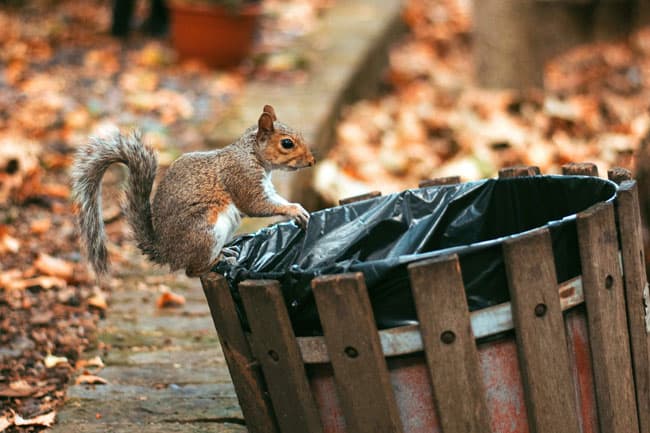
Finally, let’s also consider hedgehogs, weasels, squirrels, rats, mice, and bats, which also live in our cities.
Insects
Arthropods, including insects, can also be added to the list of city animals. Arthropods are animals with segmented bodies, such as spiders. Among insects, we can mention butterflies as well as wild and domestic bees. Some studies show that intensifying agriculture can drive insects to take refuge in urban green spaces.
It’s important to remain attentive to the evolution of both fauna and flora in cities.
The Impact of Certain Animals on Urban Biodiversity
Indeed, humans, through their travels and interests, intentionally or unintentionally cause the transfer of animals from one part of the world to another.
As a result, cities are the first places where exotic animals arrive. They find favorable conditions for their proliferation. However, Invasive Alien Species (IAS) are the second leading cause of biodiversity loss worldwide. They thrive by altering the natural ecosystem and, in doing so, can negatively impact the local wildlife.
Take, for example, the raccoon, which was originally imported from North America to Europe for its fur. An omnivore, it competes with other species and disrupts ecosystems. Additionally, it can carry certain diseases.
The Necessary Link Between Urban Life and Animal Development
In conclusion, the modern city can be seen as a specific ecosystem, with its own water, carbon, and nutrient cycles. In the end, infrastructure and architecture give nature a multitude of different shelters.
Today, we observe a real shift in mindset. Society must align its developments with ecology. It is essential to place a high value on the protection of nature and ecosystems. It is also crucial to maintain coherence in food chains, avoid the importation of non-native species, and… keep an eye on your cat!