
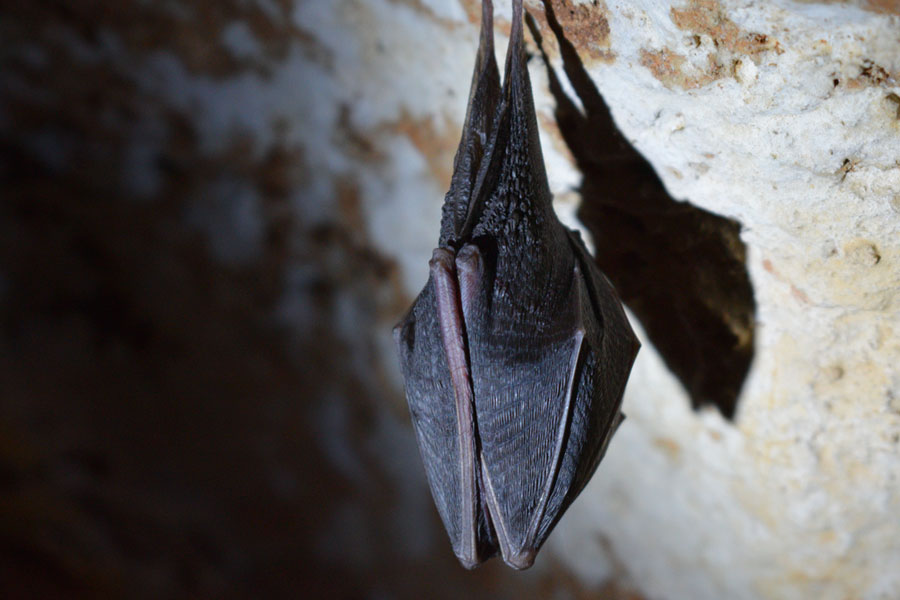
Bats are the only mammals capable of flying, thanks to their patagium, formed by their very long fingers connected by a thin membrane, which forms their wings. The vast majority of bats feed on insects, fruit, or pollen. The few “blood-sucking” species are found in Central and South America, and they have a preference for animal blood. Some species can be observed in cities, where they particularly like to take refuge in small cavities in buildings, attics, or basements. Other species prefer forest environments or rocky caves. It is possible to observe them hunting in grasslands, along waterways, or above bodies of water.

Ultrasound to Detect the Environment
The species present in Europe are insectivorous and capable of detecting obstacles and insects in the dark through echolocation. They emit sounds through their mouths or noses in a frequency range that the human ear cannot perceive. Humans can hear sounds with a frequency between 20 Hz and 20 kHz, while bats emit between 10 kHz and 180 kHz, which are ultrasounds. When the sound waves hit an obstacle or prey, the bat receives the reflected wave, called the echo, allowing it to have a three-dimensional view of its environment. To hunt effectively and move quickly, they emit these sounds continuously.
Different Hunting Techniques
Some species hunt while flying, such as the Common Pipistrelle (Pipistrellus pipistrellus), which takes advantage of the attraction of insects to lights. Others prefer to hunt over water, like the Daubenton’s Bat (Myotis daubentonii), which uses the membrane between its hind legs, called the uropatagium, as a landing net. Certain species, like the Long-eared Bats (Plecotus auritus and Plecotus austriacus), prefer to hunt from a perch or catch insects on branches or leaves of trees, which is known as gleaning.
“Swarming”
In autumn, European bats build up fat reserves for winter and begin migrating to their hibernation sites. It is also the mating season. Phenomena called “swarming” can be observed. This refers to the gathering of hundreds of individuals in a natural or artificial cavity at dusk. This gathering allows females to choose their mate and significantly increases genetic mixing between populations.
Hibernation in Slow Motion
In winter, bats survive on their fat reserves, significantly reducing their energy consumption by slowing their heart rate, respiration, and body temperature, which can range between 1 and 12°C. This state makes them particularly vulnerable to disturbances, so they need a calm, humid, and cool place during this period. In spring, they emerge from hibernation to hunt and regain strength before heading to their summer roosts. Females gather in maternity colonies, where they give birth in early summer. Males, on the other hand, spend the summer alone or in small groups. The young leave the summer roost to hunt around late July to early August to gain strength for the fall and winter.
A Bioindicator
Bats have a fast metabolism and can consume up to half their body weight in insects in one night. The state of their populations depends on the abundance of their prey and the quality of their environment. They are considered “umbrella species,” making them bioindicators of biodiversity and environmental quality. Therefore, monitoring their populations and distributions is important. One way to do this is by inventorying known hibernation and roosting sites to track species and their abundance. Since such inventories can disturb the species, it is important that they are conducted by professionals.
How can they be detected?
To inventory species diversity and quantify bat activity, it is also possible to identify them using the ultrasounds they emit. This type of survey is useful to assess the environmental pressure and identify the species visiting a particular area. Since humans cannot hear these sounds, a detector that converts them into audible sounds is needed. The most common techniques to make ultrasounds audible are frequency division and heterodyning. These methods are used in real-time with active sensors in the field. Frequency division involves dividing a frequency (e.g., 70 kHz) by 10 to make it audible at 7 kHz. Heterodyning involves listening to the difference between the captured sound and the sound adjusted by the detector. The lower the sound, the closer the frequency is to the one emitted by the bat. The user must manually adjust the detector’s frequency to match the bat’s ultrasound frequency.
Time expansion is typically used with passive detectors, which allows sound recording and post-analysis. This method records the sound at real-time speed and stretches the signal over time, reducing the number of oscillations per second and making it audible. This technique helps preserve the signal’s characteristics. The recorded signals can also be analysed with computer programs that allow for species identification based on their structures, durations, and frequencies by analysing oscillograms and spectrograms.
Endangered Species
Bats are highly dependent on their environment, making them especially vulnerable. In Wallonia, 40% of bat species are threatened with extinction, and 30% are near threatened. Only four species are considered of minor concern regarding extinction, according to the 2020 Red List of Bats in Wallonia. This decline is linked to the massive decrease in biodiversity and insects, which are their food source. Habitat loss is also a cause of their decline, particularly with the loss of cavities, blocked entrances in buildings, and the reduction of forest areas and hollow trees. The fragmentation of forest habitats is a factor that severely limits the movement of certain species, such as the Lesser and Greater Horseshoe Bats (Rhinolophus hipposideros and Rhinolophus ferrumequinum), which dislike being exposed and are therefore vulnerable to predation. Additionally, light pollution restricts the movement of the most light-sensitive species, those that avoid exposure to light due to predation risks. In Wallonia, one out of two species is considered light-sensitive. Others take advantage of the light, which attracts insects, particularly around street lamps, but this is not beneficial. Insects stay clustered around the lights instead of feeding and reproducing, which significantly exacerbates their decline and harms insectivore biodiversity. To protect them, many bat species are protected in Europe. For instance, in Belgium, France, and Switzerland, all native species are protected.
How to Help Them?
Beware of Light Pollution
We can all take action to help save bats at various levels. It is essential to reduce light pollution by removing unnecessary outdoor lighting, especially decorative lights. Urban lights or road lights should be considered essential and directed downward without illuminating natural refuges (hedges, ponds, trees, etc.) and glass facades that reflect light. Diagnosing a “black frame,” which considers biodiversity-friendly habitats and light pollution, can help define the movement areas of light-sensitive biodiversity and guide the design of lighting installations based on environmental and public lighting needs. The wavelengths of bulbs or LEDs should be warm colors (yellow-orange) or use a colored filter to transform white light into a warm color.
Welcome Them
Do not block the cavities in homes and buildings. You can also add bat boxes to provide additional shelter. Preserving aging and hollow wood also offers potential shelter for certain species. You can enhance overall biodiversity, and consequently, support bat populations, with extensive garden and green space management. For example, limit or stop the use of pesticides, provide local floral resources, opt for high mowing or late mowing, or even create a “natural” pond.
Observe Them
If you observe bats, you can report your sightings via websites or mobile apps for naturalistic observations (https://observations.be/ for Belgium, NaturaList by Biolovision for France and Switzerland, iNaturalist internationally, etc.). In the case of nuisances, such as a colony in your attic, since these species are protected, it is necessary to inform bat protection organizations that can help you find solutions (Plécotus and Zoogdiervereniging for Belgium, CPEPESC or SFEPM for France, Koordinationstelle Ost für Fledermausschutz KOF in Switzerland, etc.).